
Lesson 1 of 1
Take a bearing: the compass in ten minutes
How a compass finds north, what a bearing is, and how to take one with three different kinds of compass.
Cloud drops on a summit faster than most people expect. One minute you can see the whole ridge; the next you can see ten metres of wet grass. The people who walk off calmly are the ones who took a bearing while they could still see where they wanted to go. This free taster shows you how, then puts you on the summit of Corn Du to do it for real.
What a bearing is
A bearing is a direction given as an angle, measured clockwise from north, from 000 to 360 degrees. East is 090, south 180, west 270. "Pen y Fan is on a bearing of 060 from here" means: face north, turn 60 degrees clockwise, and Pen y Fan is straight ahead.
Bearings are always written with three figures (060, not 60) so nobody misreads them, and they are read to the nearest degree or two.
How a compass finds north
A compass needle is a small magnet. It swings to line up with the Earth's magnetic field, its red end pointing to magnetic north. Magnetic north is not quite the same as the north on a map (grid north), and the difference changes with place and year. In Britain at the moment the two are within about 2 degrees of each other, so for this taster you can treat them as the same. The full course shows you how to correct for the difference anywhere in the world.
The needle needs a moment to settle. Hold the compass level and still, and keep it away from metal: a phone, a car, a steel gate or a bar of chocolate in foil can pull it several degrees.
Three kinds of compass
The baseplate compass
The walker's compass: a clear plastic plate with a turning dial (the housing) on it.
- Hold it flat at your waist, with the direction-of-travel arrow pointing straight at the thing you want a bearing to. Face it squarely; turn your whole body, not just the compass.
- Turn the dial until the red end of the needle sits exactly inside the orienting arrow printed on the bottom of the housing. People remember it as "red in the shed".
- Read the bearing where the dial meets the index line, at the top of the housing.
The mirror sighting compass
A baseplate compass with a hinged mirror and a sight. You hold it at eye level, look at the target through the sight, and watch the needle and the orienting arrow in the mirror while you turn the dial. Because you sight along it at eye level, it is more precise than a baseplate compass held at the waist: 1 or 2 degrees instead of 3 or 4.
The lensatic compass
The army-style compass. There is no dial to set: the numbers are printed on a card that turns with the needle. You look through the rear sight and lens, line the front sighting wire up with the target, wait for the card to stop swinging, and read the bearing under the hairline.
Mistakes people make
- Pointing the compass roughly at the target, then turning only the compass to read it. The direction-of-travel arrow must point at the target.
- Reading the dial before the needle has stopped swinging.
- Putting the white (south) end of the needle in the shed: the bearing comes out 180 degrees wrong, and you walk the opposite way.
- Taking a bearing next to a car, a fence or your phone.
Your turn
Field event
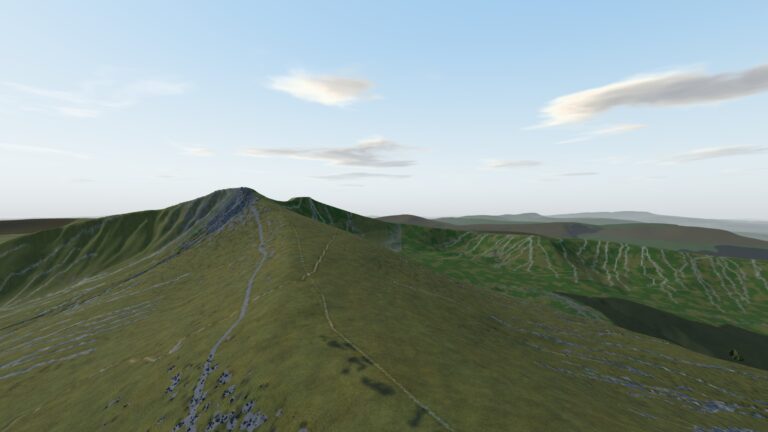
Take a bearing on Pen y Fan
Pen y Fan and Cwm Llwch, Bannau Brycheiniog (Wales)
The event is being built on the real landscape.
You stand on the summit of Corn Du, 873 metres up, with five orange markers on the peaks, the ridge and the lake around you. Take a bearing to each one with any of the three compasses. Get within 5 degrees of each for a good score.
The practical is the next step in this taster. You can also try it now without saving your score.
Key points
- A bearing is an angle clockwise from north, written with three figures.
- Point the direction-of-travel arrow at the target, put red in the shed, read at the index line.
- Let the needle settle, and keep metal away.
- 5 degrees out is 90 metres off line after a kilometre.
Enjoying the free module? The full course carries on from here.
Original price was: £149.00.£99.00Current price is: £99.00.
Places on the full course open soon. Module 1 is free to try now.
Already have the course? Log in